


A short video introducing the SCQF and describing SCQF Levels and Credit points. Watch to find out how it is important to understand what these mean.
You can also use an Interactive version of the Framework on the SCQF Website
Not sure what NQ, HNC or HND means? You’re not alone. Understanding the different qualifications can help you choose a course that suits your experience, interests and plans.
At Glasgow Kelvin College, you can build your confidence, develop practical skills and work towards further study or employment. This guide explains the qualifications you’ll see on our course pages and how they fit together.
Most of our course pages show a Scottish Credit and Qualifications Framework (SCQF) level. This tells you how advanced the learning is.
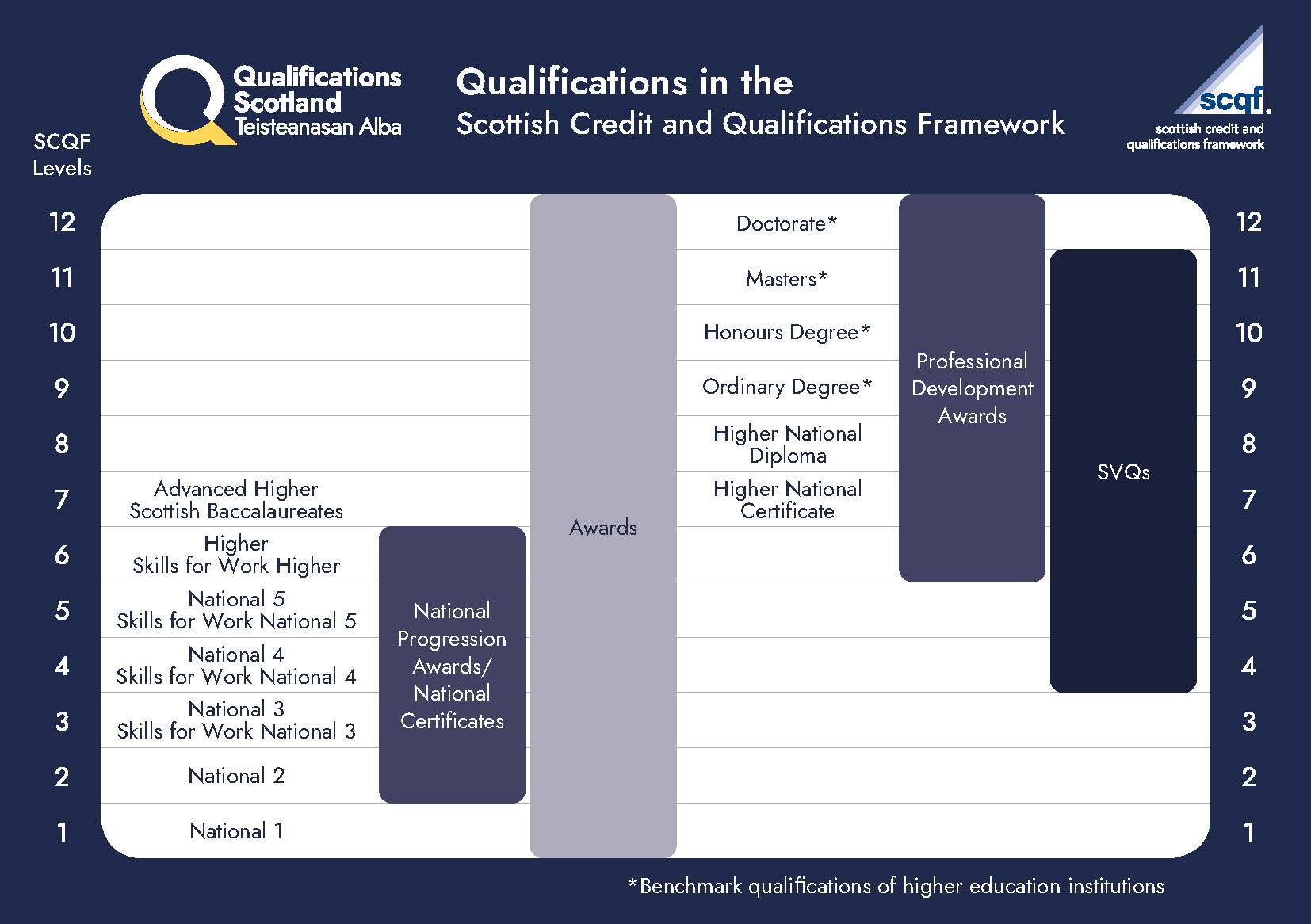
The SCQF has 12 levels, from introductory learning at Level 1 to doctoral study at Level 12.
Some familiar examples are:
National 4: SCQF Level 4.
National 5: SCQF Level 5.
Higher: SCQF Level 6.
Higher National Certificate (HNC): SCQF Level 7.
Higher National Diploma (HND): SCQF Level 8.
Ordinary degree: SCQF Level 9.
Honours degree: SCQF Level 10.
Different qualifications can sit at the same level while covering different subjects, skills and amounts of learning. For example, a college course at Level 6 is not automatically the same qualification as a Higher.
You don’t have to start at Level 1 or work through every level. Your starting point will depend on the course requirements, your qualifications and any relevant experience.
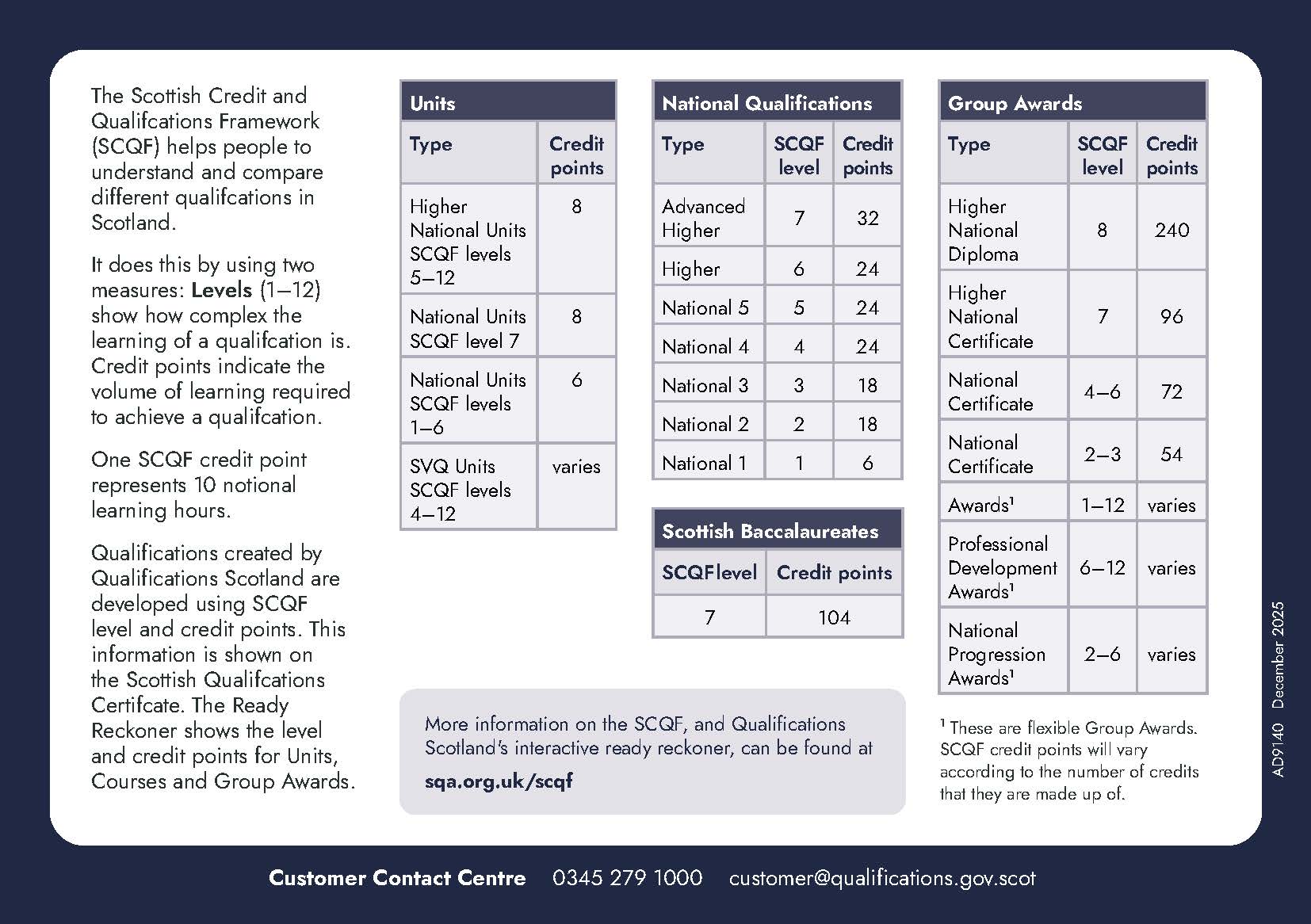
Credit points show how much learning a qualification involves. They include time spent in classes, practical activities, independent study and assessments.
One SCQF credit point represents around 10 hours of learning.
The level tells you how advanced the learning is. The credit points tell you how much learning is involved. Credit points are not your grade.
You’ll see NQ in the names of many college courses. These courses can help you explore a subject, build practical skills and prepare for further learning or work.
NQ courses are available at different levels. Some are suitable if you have few or no formal qualifications, while others ask for previous qualifications or experience.
Check the individual course page to see what you’ll study, the entry requirements and where the course could take you.
An NC brings together a group of units in a particular subject or career area. You’ll develop subject knowledge and practical skills, alongside wider skills that are useful for learning and work.
NCs are available at SCQF Levels 2–6. Depending on the subject and level, an NC can help you move into employment or prepare for a more advanced course, such as an HNC.
An NPA focuses on a particular set of skills in a subject or career area. It is usually smaller than a full college programme and may be studied on its own or as part of a wider course.
NPAs are available at SCQF Levels 2–6 and can help you explore an interest, develop practical skills or prepare for your next step.
SCQF Level 7
An HNC combines practical skills with the knowledge you need to understand your subject in more depth. It can prepare you for employment or further study.
An HNC usually takes one year of full-time study. Part-time options may take longer.
Depending on your subject, results and the course requirements, you may be able to progress to a related HND or a university degree. Some universities accept a relevant HNC for entry into the second year of a degree.
SCQF Level 8
An HND develops your subject knowledge and practical skills further, helping you prepare for employment or degree-level study.
An HND usually takes two years of full-time study overall. If you already hold a relevant HNC, you may be able to enter the second year and complete the HND in one further year.
Some HNDs can lead to entry into the second or third year of a related university degree. This depends on the university, subject, grades and any progression agreement in place.
An SVQ recognises the skills and knowledge needed to do a particular job. You demonstrate that you can carry out tasks to the standards expected in that industry.
Assessment usually takes place in the workplace or a suitable working environment. SVQs are available at different levels and often form part of a Modern Apprenticeship.
A PDA helps you develop specialist skills for a particular area of work. It can support career development, help you take on new responsibilities or prepare you for a specific role.
PDAs are available at different levels, so the entry requirements and amount of study vary. Check the course page to find out whether a particular PDA suits your experience and goals.
A degree allows you to study a subject in depth. You’ll see titles such as Bachelor of Arts (BA) and Bachelor of Science (BSc).
In Scotland, an ordinary degree is normally at SCQF Level 9 and an honours degree at Level 10.
Studied full-time from the first year, an ordinary degree usually takes three years and an honours degree four years. A relevant HNC or HND may allow you to join a degree at a later stage, depending on the entry requirements.
An apprenticeship is a route into learning and work, rather than one single qualification.
Modern Apprenticeships combine paid employment with training towards recognised qualifications. You develop skills on the job, supported by an employer and a training provider such as a college.
Foundation Apprenticeships give school pupils opportunities to develop work-related skills alongside their school subjects.
A pre-apprenticeship course helps you prepare to apply for an apprenticeship. It develops introductory skills and experience, but completing it does not guarantee an apprenticeship job.
Start with the subject you’re interested in and what you’d like to do next. Then check:
Entry requirements: Do your qualifications or experience match what the course asks for?
What you’ll learn: Does the content fit your interests and goals?
Study options: Will the location, timetable and duration work for you?
Future prospects: Could it lead to the job, apprenticeship or further study you have in mind?
There’s more than one route through college. You might move from an NQ or NC to an HNC, continue to an HND and then apply for a degree. You could also move into employment or an apprenticeship at an earlier stage.
Your route will depend on your subject, progress and plans. Progression is subject to the entry requirements for your next course.
Whether you’re leaving school, returning to learning or changing direction, you don’t need to work it all out on your own.
Explore our courses or contact our Advice and Guidance team for help understanding your options and choosing where to start.
Use the qualifications guide and video below to see how different qualifications fit into Scotland’s framework.
Click on the image to see a larger view
A short video introducing the SCQF and describing SCQF Levels and Credit points. Watch to find out how it is important to understand what these mean.
You can also use an Interactive version of the Framework on the SCQF Website